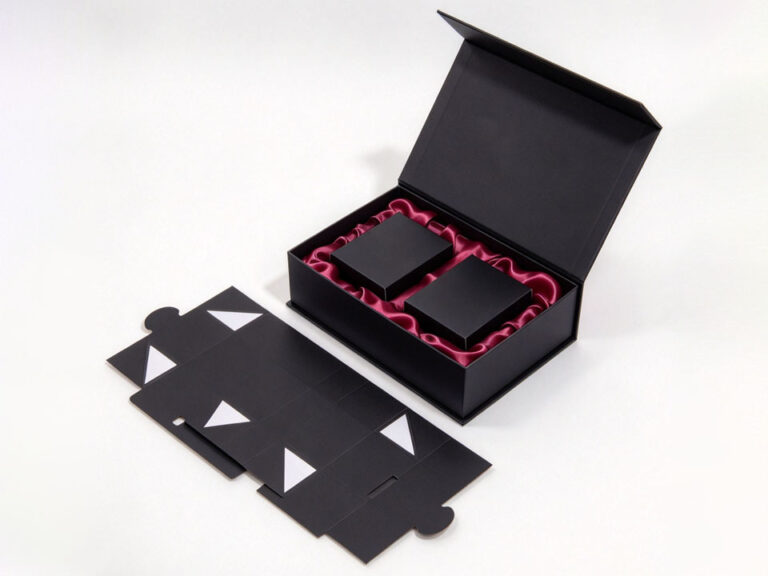
Collapsible Gift Boxes: Best Uses for Retail and Gifting
Discover where collapsible gift boxes work best, from cosmetic sets to champagne gifts. Compare inserts, product protection, retail assembly, and RFQ requirements before choosing a packaging supplier.
Collapsible gift boxes work best for products that need a structured gift presentation while allowing empty packaging to travel and wait in storage flat. Strong applications include cosmetic sets, perfume collections, boxed chocolates, jewelry, candles, and champagne gifts. The right choice depends on product support, the filling process, and the route to the recipient.
For a brand manager or packaging buyer, the question is more specific than whether the box looks premium. Will store staff assemble it at checkout? Will a fulfillment team pack several items into a seasonal set? Does a glass bottle need additional shipping protection? Those situations place different demands on the same packaging format. The following guide compares the most useful applications and explains the specifications that turn an attractive concept into a reliable retail or gifting package.
Where Do Collapsible Gift Boxes Add the Most Value?
A collapsible rigid gift box combines stiff board panels with engineered folding connections so the empty structure can be supplied flat. Assembly secures the walls and corners before filling. Magnetic flaps, ribbons, and other closures are optional design features; they do not define whether the box collapses.
The strongest fit is a program where presentation matters, empty-box storage is constrained, and assembly can be incorporated into the packing workflow. Seasonal collections, boutique retail, and manually assembled corporate gifts are useful examples.
There are limits. A filled box occupies its assembled volume. Some permanent corner bonds prevent flattening after use. A bulky insert can reduce the logistics advantage, and a presentation box still needs its own transport assessment.
Application
Most useful role
Main design priority
Condition to resolve before ordering
Cosmetics
Coordinated skincare or makeup sets
Product layout and dispenser clearance
Container variation and insert installation
Perfume
Fragrance launches and discovery collections
Glass-bottle retention and cap clearance
Leakage and transport classification
Chocolate
Seasonal assortments and corporate gifts
Suitable food-contact layers and cavity layout
Contact conditions, odor, and temperature exposure
Jewelry
Occasion gifting and coordinated accessories
Secure, accessible product support
Contact-material compatibility and removal access
Candles
Jar candles and home-fragrance sets
Vessel support and separation
Breakage risk and outer shipping protection
Champagne
Celebrations and hospitality gifting
Filled-bottle load and geometry
Base strength, bottle movement, and delivery route
Cosmetic Sets: Organize Several Products Into One Retail Offer
Collapsible boxes are worth considering for skincare routines, coordinated makeup collections, and limited-edition beauty sets. A fitted layout can make several containers read as one collection while giving the brand space for instructions or campaign artwork.
For cosmetic collapsible gift boxes, develop the layout around the packed containers. Include pumps, caps, protective seals, and any cartons that remain around individual products. Confirm that the insert supports the containers without pressing on dispensers or lifting the lid.
Decide whether the contents will remain fixed for the entire campaign. If bottle sizes or assortments may change, separate the durable outer-box specification from replaceable inserts or sleeves. Reusing one footprint can simplify purchasing, provided each assortment fits securely.
Do not use one loose cavity to accommodate every bottle. That may reduce insert variants while creating movement and inconsistent presentation. Prototype the smallest and largest containers, then approve the supported range explicitly.
Perfume: Build the Presentation Around Bottle Protection
Perfume collections, discovery sets, and fragrance-plus-accessory gifts can benefit from a controlled reveal. The packaging needs to hold the bottle in its intended orientation and allow removal without pulling on a decorative cap.
When specifying perfume collapsible gift boxes, provide filled-bottle weight, base dimensions, shoulder shape, cap height, and closure details. Design support around appropriate bottle surfaces rather than assuming that a tight cap opening will restrain the whole product.
A display insert and transport cushioning serve different functions. If the gift box enters parcel distribution, check the product, insert, box, and outer shipper together. Also review leakage and material compatibility under the intended handling conditions.
Chocolate: Separate Gift Presentation From Food-Contact Performance
Chocolate assortments suit seasonal gifting, hospitality programs, and corporate presentations, particularly when the outer box carries a coordinated selection of individually protected products. The structure can also support an organized tray, provided the food-contact arrangement is assessed separately.
For chocolate collapsible gift boxes, establish whether chocolates are sealed, individually wrapped, held in cups, or exposed directly to the tray. Those details determine which materials and conditions the supplier must evaluate.
Check tray movement, cavity depth, lid clearance, and odor from the finished packaging. Define any barrier or protective layer by function. Paperboard appearance alone does not demonstrate suitability for contact with chocolate.
Temperature management remains a separate requirement. An ordinary decorative rigid box is not a validated insulated shipping system. If the delivery route creates a heat risk, develop and test the complete thermal and transport solution before launch.
Jewelry: Prioritize Product Support Over Unnecessary Box Volume
Jewelry gifts often need a clear focal point and easy access to a small, delicate product. Collapsible packaging can work for coordinated collections, accessory sets, or an outer presentation box around smaller jewelry cases. For very small single pieces, compare a compact pre-assembled box as well; the folding mechanism may offer little practical advantage.
Develop jewelry collapsible gift boxes around the actual piece and its support. Rings need suitable slots, earrings need secure mounting, and chains need routing that limits tangling without loading the clasp.
Review removal as carefully as retention. Customers should be able to access the product without bending a display card excessively or pulling on a fine chain. Ask for samples containing representative finished items.
For tarnish-sensitive metals or delicate surface treatments, specify compatible contact materials and an appropriate validation period. A velvet-like surface is a visual description, not proof that the lining, adhesive, or backing suits the product.
Candles: Distinguish the Display Box From the Shipping System
Jar candles and home-fragrance collections can use collapsible gift packaging to coordinate vessels, lids, and accessories. The main challenge is supporting dense, potentially fragile products while keeping the finished set neat and easy to pack.
For candle collapsible gift boxes, provide the filled vessel’s dimensions and weight, including the lid. Decide where the insert supports the jar, how accessories are separated, and whether the vessel can move enough to contact adjacent components.
In a candle-maker sourcing discussion, a respondent first clarified whether the buyer meant a branded candle box, a case pack, or a carrier shipping box. That distinction is useful qualitative industry insight: a request for “candle packaging” can describe three different jobs. reddit.com
Write those jobs separately in the brief. The retail box presents the candle; the case pack groups units; the shipping system protects the order through its delivery route. One construction may perform more than one role, but that capability needs evidence.
Also evaluate the actual wax, label, and vessel finish under expected storage conditions. Avoid placing a fragrance item alongside odor-sensitive food without assessing separation and compatibility.
Champagne: Specify the Filled Load Before the Decorative Finish
Champagne presentation boxes suit celebrations, hospitality gifts, and selected corporate programs. A collapsible format is most useful where empty boxes can remain flat until the bottles are packed, provided the erected construction supports the filled load reliably.
For champagne collapsible gift boxes, supply a bottle sample or dimensioned drawing. Nominal liquid capacity does not define the bottle’s outside geometry. Include shoulder shape, maximum diameter, overall height, and filled weight.
Check the base, corner connections, insert support, and bottle-removal method. For multi-bottle sets, prevent bottle-to-bottle contact. If a handle is proposed, validate the complete load path through the handle attachment and box structure.
A magnetic lid holds a flap closed; it does not establish carrying strength. Likewise, a retail presentation sample does not demonstrate parcel-shipping performance. Confirm the intended delivery arrangement before selecting the final box and protective components.
Match the Box to the Retail or Gifting Workflow
Assembly at the Retail Counter
Flat stock can help stores with limited backroom space, but checkout operations need predictable handling. Test whether staff can identify the folds, secure corners, load the product, and finish the pack without confusing steps.
Prepare a small working stock of assembled boxes if demand warrants it. Keep the remaining inventory flat. Time the complete transaction-related packaging sequence, including ribbon tying or personalization, rather than quoting only the box-erection time.
Pre-Filled Seasonal and Corporate Sets
Centralized kitting can accommodate assembly before products reach stores or recipients. Coordinate box quantities with inserts, products, cards, and any recipient-specific content. An unavailable insert can hold up the same launch as an unavailable box.
Consider a small family of box sizes with interchangeable campaign components. Standardization helps only when it preserves product support and avoids excessive filler. Check actual pallet and master-carton arrangements for the filled sets.
E-Commerce Gift Orders
A gift-ready interior may add value to an online order, but the exterior must still survive distribution. Plan the shipping system early enough that its size, cushioning, and packing labor enter the cost comparison.
For mixed-category gifts, assess interactions between products. Separate heavy glass from delicate accessories, confirm closures remain secure, and review odor-sensitive combinations. A coordinated visual theme does not establish compatibility within one pack.
When Is a Collapsible Gift Box the Wrong Choice?
A collapsible structure is less attractive when empty-box storage is inexpensive, the format is very small, or the filling operation cannot absorb another assembly step. A pre-assembled rigid box may then offer a more predictable workflow.
It may also be unnecessary when the product needs a simple retail carton or a delivery-focused mailer. Premium presentation should have a defined role in the offer; adding a rigid box to every SKU can create cost without solving a buyer or operational need.
Evaluate the complete packaging set, not just the folding shell. A large formed tray may travel at full volume, reducing the benefit of flat delivery. Permanent adhesive corners may also prevent repeated collapsing after assembly.
Compare box price, inserts, tooling, inbound freight, storage, assembly, outer shipping protection, and expected rework. The useful purchasing question is whether the whole system delivers the required presentation and protection at an acceptable cost per saleable order.
What Should Buyers Validate Before Approving Production?
Approve a production-representative sample with the intended board, wrap, closure, corner system, and insert. A plain prototype can establish geometry, but it cannot validate finished-surface durability or the behavior of all selected materials.
Run a pilot packing session with the people who will assemble the order. Record corner failures, insert-loading problems, lid interference, and time per completed pack. Agree visual defect criteria for scuffing, exposed board, print variation, and closure alignment.
Set acceptance criteria before testing: intact products, retained position, acceptable cosmetic condition, and functioning closures. A gift can arrive unbroken yet still be unsuitable for presentation because the box is crushed, marked, or partly separated.
What Information Should Go Into the RFQ?
Give suppliers a clear application and workflow so they can quote the same responsibilities. Include:
Contents: product samples, dimensions, filled weights, and assortment variants.
Layout: orientation, internal usable dimensions, inserts, accessories, and removal access.
Construction: board grade and thickness, folding method, corner attachment, and closure.
Contact requirements: relevant food-contact or product-material compatibility conditions.
Branding: artwork, colors, wrap materials, finishes, and reference samples.
Quantity: volume per size and artwork, repeat-order expectations, and MOQ requirements.
Validation: sampling stages, inspection criteria, and agreed product and distribution tests.
Logistics: flat or erected delivery, carton data, destination, delivery terms, and arrival deadline.
Request a cost breakdown where it helps comparison, and confirm when the production lead time starts. Choose the application-specific construction that meets the approved brief rather than ordering a generic gift box and adapting the product around it.
Frequently Asked Questions
Which Products Are Best Suited to Collapsible Gift Boxes?
Beauty sets, fragrance collections, chocolates, jewelry, candles, and champagne are useful candidates when presentation and flat empty-box storage both matter. Product weight, support requirements, packing capacity, and the delivery route determine whether the format is appropriate.
Can Collapsible Gift Boxes Replace Shipping Cartons?
Only when the complete package has been validated for that delivery route. Stiff panels and a magnetic closure do not establish shipping suitability. Decorative boxes may require an outer carton and cushioning to protect both the product and its presentation.
Are Collapsible Gift Boxes Suitable for Unwrapped Chocolates?
They can be developed for that use only with suitable food-contact components and supporting documentation. Specify the food, contact surfaces, storage conditions, and protective layers. A decorative outer box or generic “food-grade” claim does not establish suitability for the complete pack.
Can One Box Size Serve Several Gift Collections?
Yes, if each assortment fits securely within the same internal envelope. Different inserts, sleeves, or cards can support variations. Test the smallest and heaviest combinations so standardization does not create excessive filler, unstable contents, or closure problems.
Do Collapsible Gift Boxes Always Reduce Freight Costs?
No. Savings depend on the complete shipment, including inserts, accessories, carton packing, and weight. Compare equivalent quantities and delivery terms. Flat delivery primarily affects empty packaging; filled gifts still occupy their assembled dimensions.
What Should Buyers Test for Candle and Champagne Packaging?
Test the filled product, insert, base, corners, closure, and outer shipping protection together. Check movement, breakage, load support, and cosmetic damage under the intended handling conditions. Test any carrying handle as part of the loaded structure.