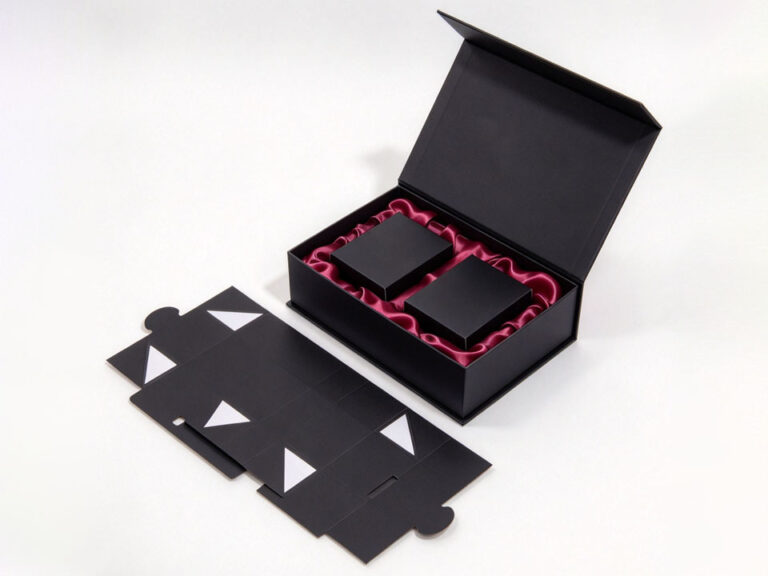
What Are Foldable Gift Boxes? How to Choose the Right Type
Compare foldable gift box constructions, closures, and inserts. Learn how to specify watch cushions, jewelry supports, dimensions, and sample checks before requesting supplier quotations.
Foldable gift boxes are presentation packages designed to arrive or remain flat until assembled around a product. The term covers lightweight folding cartons and collapsible rigid constructions, so two boxes described as “foldable” can offer very different stiffness, assembly methods, and opening experiences.
For brands sourcing jewelry, watch, or seasonal gift packaging, the right type depends on the product’s dimensions, its support needs, and how the box will be filled and delivered. Color and decoration come later. A double-door design can create an attractive reveal, but its value disappears if the doors catch on the insert or the watch cushion prevents closure.
Start by separating construction, opening style, and product support. This guide explains those choices and turns them into practical checks for quotations, prototypes, and production approval.
What Makes a Gift Box Foldable?
A gift box is foldable when its engineered creases, joints, or panel connections allow it to move from a flat configuration into a usable box. The mechanism varies with the construction.
A folding carton generally starts as a die-cut, scored paperboard blank. A collapsible rigid gift box uses stiff board panels connected by flexible wrapped sections or other folding features. Corners may be secured with adhesive tabs, mechanical connections, or a design-specific assembly system.
A pre-assembled rigid box retains its erected shape through normal delivery and filling. It may have a hinged magnetic lid and still be non-collapsible.
These descriptions answer different questions. “Magnetic” identifies a closure; “double-door” describes the opening; “collapsible” describes the storage and assembly format. They are not mutually exclusive box categories. Ask the supplier to demonstrate the complete flat-to-assembled sequence rather than relying on a product name.
Which Foldable Gift Box Type Fits Your Project?
Select the construction first, then the opening and insert. The following comparison identifies sensible starting points rather than guaranteed performance levels.
Design option
Suitable starting application
Why consider it?
What must be checked?
Scored paperboard folding carton
Lightweight accessories or small retail gifts
Compact flat supply; some structures suit machine erection
Required stiffness, locking method, and equipment compatibility
Collapsible rigid box with a single hinged lid
Jewelry sets, watches, and curated gifts
Rigid presentation surfaces with one main opening panel
Corner attachment, lid clearance, and insert installation
Collapsible rigid box with a ribbon closure
Occasion gifts and manually packed collections
A tied opening can support the gifting presentation
Ribbon attachment, tying time, and separate product retention
Collapsible double-door box
Centrally displayed watches or coordinated sets
Two opening panels can frame the product reveal
Door alignment, opening space, closure sequence, and insert interference
Re-collapsible construction
Programs requiring repeated flattening
Can return to a flat condition if designed for it
Joint durability and whether assembly uses permanent adhesive
Avoid specifying every decorative feature at once. A complex lid, thick wrap, multiple magnets, and a tightly fitted insert create several interacting tolerances. Shortlist the simplest structure that satisfies the product and presentation brief, then justify additional features individually.
Start With the Product and Define Usable Space
Choose the smallest practical internal envelope that accommodates the product, support, removal access, and necessary protection. External box dimensions alone cannot establish fit.
Record the product in its packed configuration. A necklace arranged on a display card has a different footprint from the same necklace coiled in a pouch. A watch on a cushion occupies more height than its case thickness suggests.
Give the supplier maximum dimensions across the intended product range, including protruding crowns, clasps, buckles, and accessories. Add the insert, paperwork, and any protective layers to the layout before fixing box dimensions.
For example, a hypothetical watch case measuring 42 mm across does not justify a 42 mm insert opening by itself. The crown may extend farther, the strap needs a path around the support, and the assembled cushion changes overall height. The example illustrates a measurement problem, not a recommended clearance.
Specify internal usable length, width, and height, with a drawing showing orientation and measurement points. Agree critical tolerances with the supplier. Generic instructions such as “make it a little bigger” leave fit decisions unresolved.
How Do You Choose Inserts for Watches and Jewelry?
Watch Cushions Must Fit the Fastened Strap
A watch cushion should support the watch without requiring excessive strap or bracelet tension. Its width, compressibility, circumference, and installed height all matter.
A watch-collector question in a Reddit discussion about watch accessories describes an inner cushion too large for the owner’s bracelets to clasp. This is an individual user report rather than evidence of an industry-wide failure rate. It nevertheless identifies a useful procurement check: validate the cushion with the smallest intended fastened bracelet, not just the largest watch case. reddit.com
If your brief calls for a dark exterior and a light cushion, the black collapsible watch gift box with beige cushion is a relevant product reference. Request the cushion dimensions, construction, and a sample with your actual watch before adopting a similar arrangement.
Also check crown clearance, the clasp’s position beneath the cushion, and whether the watch moves during handling. Approve the cushion and surrounding insert together; a well-sized pillow can still shift inside an oversized cavity.
Jewelry Inserts Need Retention and Removal Access
Rings, earrings, chains, and pendants require different support features. A slit suitable for a ring may not support a pendant, while a chain needs routing that prevents tangling without pulling on a clasp.
For a ribbon-led presentation, use the matte black collapsible jewelry box with pink satin ribbon as a design reference, then specify the jewelry support separately. The ribbon treatment does not establish how the contents will be held.
Review all product-contact surfaces, exposed adhesive, cut edges, lint, and ease of removal. For tarnish-sensitive metals or delicate coatings, ask for material compatibility evidence appropriate to the product and expected storage period. A soft appearance alone does not establish suitability.
When Should You Choose Single-Lid or Double-Door Packaging?
A single hinged lid is a sensible starting point when the product should be accessed from one direction and the packing workflow favors a straightforward closure. A double-door opening can suit a centered display, provided both panels clear the product and operate consistently.
Check the Full Opening Path
For a two-panel concept, the burgundy floral double-door collapsible watch box provides a relevant style reference. Request a video showing assembly, both doors opening, and closure with the intended insert installed. A closed-box photograph cannot show panel interference.
Confirm the footprint when fully open, particularly for retail counters and packing benches. Check whether the doors must close in a specific order and whether operators can identify that order without trial and error.
Treat Alignment as a Measurable Requirement
For a contrasting exterior-and-interior brief, consider the white double-door watch gift box with black insert. Ask the supplier to define acceptable center gaps, panel height differences, and insert position for the proposed construction.
Do not assign an arbitrary tolerance without reviewing the manufacturing method. Agree what is achievable, what remains visually acceptable, and how QC will measure it. An approved physical sample should accompany the drawing.
Specify Board and Finishes Without Overbuilding the Box
Thicker board is not automatically a better specification. Board stiffness, panel span, joint design, wrapping, and insert support work together. Extra thickness can also increase weight and require revised folding gaps.
Specify board grade and caliper, rather than GSM alone. GSM measures mass per area; caliper measures thickness. ISO 534:2011 provides methods for measuring paper and board thickness and calculating related density and specific-volume properties. Its scope excludes corrugated fibreboard, so it should not be applied indiscriminately to every packaging component. iso.org
For decoration, inspect the intended materials after assembly. Foil near a moving joint, dark wrap surfaces rubbing against adjacent boxes, and heavily covered fold areas deserve particular attention. Review paper cracking, scuffing, fingerprints, and color consistency using a production-representative sample.
A seasonal brief might draw on the black Valentine’s jewelry gift box with red interior. Decide whether the seasonal treatment belongs in the permanent box structure or in a replaceable sleeve, card, or ribbon. That decision affects inventory flexibility as well as appearance.
If sourcing or recycled-content claims form part of the brief, request supporting documentation and specify which components the claim covers. Assess the complete material combination before making recyclability claims; a paper exterior does not describe every component inside the package.
Will Fold-Flat Delivery Improve Your Packing Economics?
Fold-flat delivery can reduce the space occupied by empty boxes, but savings depend on the shipped configuration and the assembly operation. A bulky cushion or formed insert may still travel at full volume.
For a straightforward folding concept, the scarlet red collapsible gift box with fold-flat design is a relevant reference for the supplier discussion. Ask for packed carton dimensions and an assembly demonstration before estimating logistics savings.
Compare equal quantities of complete packaging sets. Include inserts, ribbons, protective interleaves, master cartons, and pallets. Time actual operators retrieving components, erecting boxes, securing corners, loading inserts, and closing the finished pack.
FedEx explains dimensional weight as a pricing measure tied to package volume relative to actual weight, with charges based on whichever weight is greater under the described arrangement. Confirm the applicable service and account terms when comparing shipments. FedEx
This creates two separate decisions: how efficiently empty packaging reaches the filling site, and how efficiently the filled product reaches the buyer. A flat incoming box does not remain flat after filling. Compare total landed packaging cost and packing labor, then assess the final parcel independently.
What Should a Pre-Production Sample Prove?
A sample should demonstrate fit, assembly, appearance, and the required handling performance. Use approval stages so problems are resolved before expensive decoration or bulk production.
Does the complete packed system meet delivery requirements?
Agreed test plan, results, and acceptance criteria
Inspect corner bonds, folding joints, closure alignment, product retention, and accessible removal points. Test the requested reuse behavior explicitly. Reopening the lid is different from repeatedly collapsing the entire box, especially if the corners use permanent adhesive.
For shipping, validate the product, insert, presentation box, and outer packaging as a combined system. The International Safe Transit Association’s test procedures distinguish non-simulation screening from general simulations of transport hazards. Have the laboratory select the procedure that matches the actual distribution route and shipment configuration. International Safe Transit Association
Define cosmetic acceptance as well as product protection. A watch may arrive functional while its presentation box has separated corners or visible abrasion. Specify what constitutes an unacceptable delivered pack before testing begins.
What Should Buyers Include in a Foldable Gift Box RFQ?
Send a brief that makes supplier proposals comparable. Include the intended construction, the product-support requirements, and the delivery configuration—not just a reference image.
Product range: dimensions, weights, contact-sensitive surfaces, and representative samples.
Packed layout: product orientation, accessories, paperwork, and removal access.
Box dimensions: internal usable measurements, external limits, and critical tolerances.
Opening and assembly: single lid or double door, corner system, closure method, and required re-collapsibility.
Materials: proposed board grade and caliper, wrap, lining, insert, and cushion construction.
Decoration: artwork files, print coverage, color targets, foil, embossing, and finish references.
Quantity: units per size and artwork, forecast reorders, and MOQ expectations.
Validation: sampling stages, inspection criteria, required testing, and approval responsibility.
Logistics: flat or erected delivery, carton data, destination, delivery terms, and required arrival date.
Ask suppliers to separate tooling, sampling, inserts, and freight where useful. Confirm whether MOQ applies per structure, size, or artwork and whether production lead time begins after sample approval. Select the proposal that proves fit and repeatability within the project’s budget and packing capacity.
Frequently Asked Questions
Are All Magnetic Gift Boxes Foldable?
No. Magnetic closure describes how the lid stays shut. A magnetic gift box may be permanently assembled or collapsible. Request a flat-to-assembled demonstration and confirm the corner construction before specifying flat delivery.
What Is the Difference Between a Folding Carton and a Foldable Rigid Box?
A folding carton generally uses a scored paperboard blank. A foldable rigid box uses stiff panels joined by folding sections. Their stiffness, manufacturing methods, assembly requirements, and suitability for inserts differ, even though both can be supplied flat.
Can One Watch Cushion Fit Every Bracelet Size?
Do not assume so. Cushion circumference and compressibility must work with the intended fastened bracelet range. Test the smallest bracelet, largest watch case, clasp position, and installed height using representative products.
Are Double-Door Gift Boxes Better Than Single-Lid Boxes?
They suit different presentation needs. Double doors can frame a centered product, while introducing additional alignment and opening-clearance checks. Choose them when the reveal supports the brief and the approved construction performs reliably during packing and use.
Can Foldable Gift Boxes Be Flattened Again After Assembly?
Only some constructions support repeated flattening. Permanent adhesive corners may prevent it without damage. If re-collapsibility matters, state the required use cycle during development and approve samples against that requirement.
Do Foldable Rigid Gift Boxes Need Shipping Cartons?
Plan for suitable outer protection unless testing demonstrates that the complete presentation package can withstand the intended delivery route alone. Decorative surfaces, closures, and product supports need validation together; rigid panels do not establish shipping suitability.
How Can Buyers Compare Supplier Quotations Accurately?
Use the same dimensions, materials, insert design, quantities, finishes, testing requirements, and delivery terms. Compare packaging, tooling, assembly, freight, and expected rework together. A lower quoted box price may exclude components or services included in another proposal.