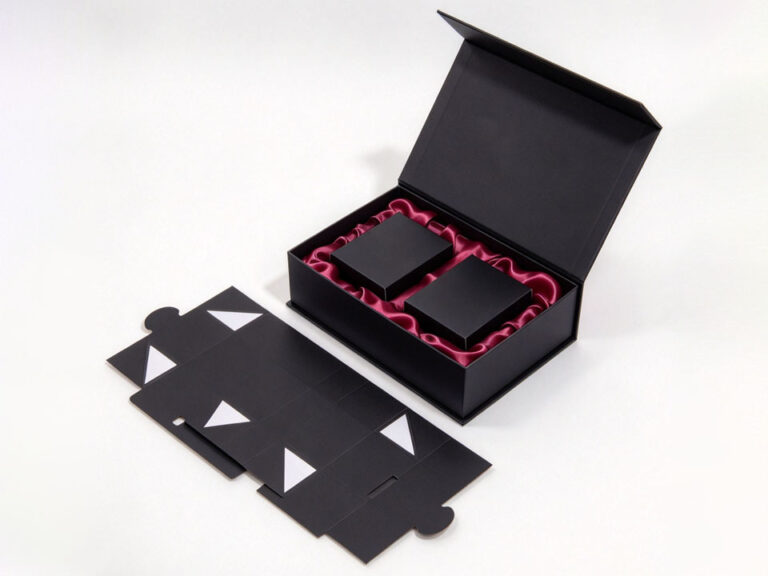
Why Foldable Gift Boxes Are a Popular Choice for Brands
Foldable gift boxes combine premium presentation with flat storage. Learn how to compare total cost, specify materials and inserts, and validate assembly and shipping performance before ordering.
Foldable gift boxes appeal to brands because they combine a structured presentation with the ability to store and transport empty packaging flat. For a procurement manager, packaging engineer, or brand manager, that combination can resolve a familiar tension: creating a gift-worthy package without committing excessive warehouse space to empty boxes.
The commercial advantage depends on the complete packaging system. A collapsible box may reduce inbound freight volume, yet require assembly labor, a bulky insert, and an outer shipping carton. Those details determine whether the format delivers useful savings or simply moves costs elsewhere. This guide focuses on foldable rigid gift boxes, explains where they earn their place, and shows what buyers should verify before approving a production order.
What Are Foldable Gift Boxes?
Foldable rigid gift boxes use stiff board panels connected by flexible wrapped joints or engineered folding sections. The structure travels flat and becomes a three-dimensional presentation box during assembly. Depending on the design, corners lock mechanically or bond with pre-applied adhesive. A hinged lid may close with magnets, ribbon, or a tuck feature.
The terminology needs care. A folding carton generally uses a scored paperboard blank, while a collapsible rigid box uses separate rigid panels and folding connections. Both can ship flat, but they have different manufacturing processes, material requirements, and assembly behavior. Also, a magnetic closure describes the lid: magnets alone do not make a box collapsible or secure its corners.
Specify the actual structure in an RFQ. A photograph labeled “foldable luxury box” leaves too much open to interpretation.
Why Do Brands Choose This Packaging Format?
Less Empty Packaging to Store
The main logistical benefit appears before the product enters the box. Flat components can occupy less storage and transport volume than comparable erected boxes, which can help brands receiving packaging well ahead of seasonal launches.
Ask suppliers for packed master-carton dimensions, quantities per carton, gross weights, and pallet layouts for both options. Include inserts and accessories in the comparison. A molded insert shipped fully formed may consume much of the space saved by collapsing the outer box.
Flat delivery does not automatically reduce the outbound parcel size after filling. Once assembled around the same product, the presentation box still needs its working dimensions and any necessary shipping protection.
A Structured Presentation for Gift Sets
Rigid panels give designers a defined surface for printed artwork, textured papers, foil accents, and an organized product reveal. These features suit projects where presentation is part of the purchase, such as a skincare launch kit or a coordinated accessories collection.
For beauty and personal care gift boxes, start with the actual bottle or jar arrangement. Pumps, caps, and dispensing heads need clearance, while inserts should support the containers without forcing the lid upward. Visual consistency matters, but it cannot compensate for poor fit.
More Flexibility Across Campaigns
A shared box footprint can support several assortments when products fit within a common size and weight envelope. Brands can update sleeves, cards, or selected inserts instead of redesigning every component for each campaign.
That approach is useful for corporate and occasion gifting boxes, where presentation may change more frequently than the underlying structure. Test the smallest and largest assortments before standardizing. A common box loses its advantage if smaller sets need excessive filler or larger sets strain the closure.
Foldable Rigid Boxes vs Other Packaging Options
Choose the format around the product, packing operation, and delivery channel. The following comparison is a starting framework; supplier-specific constructions need physical validation.
Packaging format
Strongest fit
Operational advantage
Trade-off to verify
Foldable rigid gift box
Premium sets assembled near fulfillment
Structured presentation with flat empty storage
Corner stability, assembly labor, insert volume
Pre-assembled rigid box
Projects prioritizing immediate filling
No box-erection step at the filling station
Inbound cube and empty-box storage
Folding carton
Lightweight retail products and suitable automated lines
Efficient flat supply and potential for machine erection
Delivery-led projects needing a printable shipping structure
Can combine branding and transport functions when validated
Exterior appearance after transit and product cushioning
A foldable rigid box deserves consideration when presentation and empty-storage efficiency both matter. A pre-assembled structure may still be preferable when packing capacity is constrained or the required geometry does not fold reliably.
Does Flat Shipping Actually Lower Total Cost?
It can, but the correct comparison is cost per saleable packed unit, including assembly and protection. The lowest empty-box quotation does not establish the lowest total cost.
Build the comparison from box and insert prices, tooling allocated across the expected order, inbound freight, storage, assembly, outer packaging, and expected rework. Keep delivery terms and included services consistent between quotations.
Consider an illustrative calculation, not a market benchmark. If flat delivery saves $0.30 per unit in freight and storage but adds 25 seconds of handling at a fully loaded labor rate of $24 per hour, added labor costs approximately $0.17 per unit. About $0.13 remains before additional consumables, rejects, or equipment costs. A small change in actual assembly time can change the decision.
A streetwear founder’s packaging discussion illustrates the concern: the poster separated the cost of a magnetic presentation box and accessories from labor and shipping. This is one seller’s experience, not an industry price benchmark. It demonstrates why buyers should budget the entire packed order. reddit.com
Measure the complete assembly sequence during sampling: retrieving a flat box, erecting it, securing corners, installing the insert, loading products, and closing it. Supplier demonstrations that show only the folding motion are insufficient for capacity planning.
Match the Structure to the Product’s Failure Risks
Fragile and Heavy Products
The base, corner connections, and insert must support the product together. Adding thicker board can change stiffness, but it does not automatically fix a weak corner joint or inadequate cushioning.
For wine and spirits gift boxes, provide bottle dimensions, filled weight, base shape, neck geometry, and intended orientation. Check whether the insert restrains movement and whether any carrying feature transfers the load safely through the structure. A magnetic lid is a closure, not proof of transport performance.
Delicate Surfaces and Small Accessories
For jewelry and fashion gift packaging, test the surfaces that touch the product. Insert edges, fabric coverings, adhesives, and loose accessories deserve attention. A cavity that looks precise in a drawing may grip too tightly or allow movement once production variation is included.
Request samples using representative finished products. Review removal access as well as retention: customers should not need to pull aggressively on a chain, clasp, or delicate component to remove it.
Food and Beverage Assortments
For food and beverage gift packaging, define whether the gift box holds sealed primary packs or contacts unpackaged food. The distinction changes the material suitability and documentation the supplier needs to assess for the destination market.
A decorative wrap or recycled board specification does not establish suitability for direct food contact. Explain possible contact, grease exposure, moisture, storage conditions, and odor sensitivity before selecting substrates, inks, coatings, and adhesives.
Mixed Consumer-Product Sets
Projects using lifestyle and consumer product gift boxes may combine items with different weights and fragility. Design partitions so a dense accessory cannot shift into a fragile item. Check every proposed assortment rather than assuming an approved box protects all combinations equally.
Which Material and Design Specifications Matter Most?
Board Thickness and Folding Geometry
Specify board type and thickness in millimeters, alongside agreed tolerances and required load performance. GSM describes mass per area; it cannot fully define caliper or stiffness across different board grades.
Fold gaps and wrap construction must allow panels to move into position without binding, exposing excessive gaps, or cracking the surface. Increasing board thickness without reviewing the folding geometry can create assembly problems. Approve the construction as a system rather than upgrading one material in isolation.
Closure and Corner Performance
Define acceptable lid alignment, closure behavior, corner attachment, and opening access. For magnetic designs, check correct pairing and placement, closure with the actual contents installed, and repeated opening under the intended use conditions.
Separate repeat opening from repeat collapsing. Adhesive corner tabs may create a permanent assembled structure. A box that customers can reopen many times may not be designed to flatten again without damage.
Printing and Finishing
Choose finishes against the handling conditions as well as the visual brief. Inspect scuffing on dark surfaces, fingerprints, foil registration, and paper cracking around folds. Ask for production-representative materials: a digital artwork proof cannot demonstrate wrap adhesion or finish durability.
Keep fine artwork and critical brand elements away from fold transitions unless the supplier confirms the achievable placement tolerance. A restrained finish that stays consistent through packing may serve the brand better than a complex combination that generates rejects.
Are Foldable Gift Boxes More Sustainable?
Fold-flat delivery can improve empty-packaging transport efficiency, but the format alone does not prove a lower overall environmental impact. Material quantity, inserts, transport routes, damage, reuse, and end-of-life handling all affect the assessment.
FSC’s explanation of its labels distinguishes FSC 100%, FSC Mix, and FSC Recycled. FSC Recycled identifies products made with 100% recycled fiber. These labels communicate sourcing or fiber-content attributes; buyers should assess recyclability of the finished packaging separately. Forest Stewardship Council
Under the US FTC Green Guides, Section 260.12, recyclable claims need qualification when appropriate recycling facilities are unavailable to at least 60% of consumers or communities where the item is sold. This is an access threshold, not a recycling-rate claim or a complete compliance test. ftc.gov
Ask for the complete material breakdown, including magnets, ribbons, laminates, adhesives, and inserts. Consider whether components can be separated and whether local systems accept the resulting materials. Request evidence for any environmental claim and avoid assuming that paper appearance or potential reuse proves environmental superiority.
How Should Buyers Test Samples Before Production?
Approve a sample made with the intended board, wrap, closure, corner system, and insert. A plain structural prototype can establish geometry, but it cannot validate all behavior of the finished construction.
Use a short pilot packing run with the team or fulfillment partner that will handle production. Record assembly time, damaged components, alignment problems, and product loading difficulties. Inspect boxes after realistic storage and handling, with conditioning agreed for the intended distribution environment.
Transit testing should evaluate the product, insert, gift box, and outer shipping package together. The International Safe Transit Association’s test procedures distinguish early screening tests from distribution simulation tests. Its 3-Series addresses transport hazards, and Procedure 3A concerns individual packages in parcel delivery systems. Have a qualified laboratory select the procedure appropriate to the route and shipment configuration. International Safe Transit Association
Define pass criteria before testing: product integrity, acceptable cosmetic damage, insert movement, corner separation, and lid condition. A product can remain intact while its gift presentation becomes commercially unacceptable. Retain an approved reference sample and written defect criteria for production inspections.
What Should Buyers Specify Before Requesting a Quote?
A useful RFQ gives suppliers enough information to quote the same structure and responsibilities. Include:
Product details: representative samples, dimensions, weight, fragility, and assortment variations.
Box geometry: internal usable dimensions, orientation, lid style, and assembly method.
Construction: board grade and thickness, wrap, lining, corner attachment, and closure.
Inserts: material, support points, cavity layout, removal access, and flat or formed delivery.
Artwork: print coverage, color references, finishes, and approval method.
Quality requirements: critical tolerances, defect criteria, testing, and inspection expectations.
Quantity: order volume by size and artwork, forecast repeat orders, and acceptable MOQ.
Schedule: sample approval milestones, production completion, dispatch, and required arrival date.
Documentation: relevant sourcing claims, food-contact requirements where applicable, and destination-specific evidence.
Request separate prices for tooling, samples, inserts, finishing, and transport where useful. Ask whether MOQ applies per size, print design, color, or complete order. Compare quotes against the same approved specification, then choose the construction that meets presentation and protection requirements at an acceptable packed-unit cost.
Frequently Asked Questions
Are Foldable Gift Boxes the Same as Folding Cartons?
No. Foldable rigid gift boxes use stiff panels connected by folding sections, while folding cartons generally use a scored paperboard blank. Both may ship flat, but their construction, stiffness, assembly methods, and production requirements differ.
Do Foldable Gift Boxes Always Save Shipping Costs?
No. Savings depend on packed shipment volume, weight, rates, and accessories. Compare master-carton data for equivalent quantities, including inserts. The main benefit usually concerns transporting empty packaging; filled customer parcels may remain the same size.
Can Magnetic Gift Boxes Ship Without an Outer Carton?
Only if the complete packaging system has been validated for that delivery route. A magnetic closure does not establish shipping suitability. Presentation boxes may need an outer carton and cushioning to protect both the product and the decorative surface.
Can a Foldable Gift Box Be Flattened After Assembly?
Some designs can; others use permanent adhesive corners. Specify repeated collapsing during development if required, and test representative samples. Reopening the lid and flattening the structure are different functions.
What Board Thickness Should Buyers Specify?
Choose thickness through structural development using product weight, box span, joints, and insert support. There is no universal specification for every gift box. Request the proposed board grade, caliper, tolerances, and evidence from loaded samples.
What Determines MOQ and Production Lead Time?
Size, artwork variations, material availability, finishing, tooling, and production capacity affect both. Confirm MOQ per specification and ask when the production clock starts. Sample approval, manufacturing, freight, and customs should appear as separate schedule stages.